

What Should I Look for in a Fabricator for Data Center Steel Work?
Short answer: Look for a fabricator who keeps cutting and forming under one roof, reviews prints before fabrication starts, and has a clear process for holding tolerances across a full run. Data center steel work is unforgiving — parts either fit or they don’t — and most problems trace back to a disconnect between cutting and forming operations, not the fabrication itself.
Why Fabricator Selection Matters More on Data Center Jobs
Data center construction moves fast and has little tolerance for field fixes. Unlike general structural work where minor fit-up issues get absorbed on site, data center installs often involve pre-engineered systems where every bracket, frame, and support has to land exactly where it’s supposed to.
When a part is off, it doesn’t get shimmed and called good. It creates a delay. And delays on a data center build are expensive.
The fabricator you choose determines whether your parts show up right the first time or whether your crew spends install day making things work that should have already worked.
The Key Things to Look for in a Data Center Steel Fabricator
1. Cutting and Forming Under One Roof
This is the single most important factor.
When cutting and forming happen at separate facilities, coordination breaks down. The cut is made to one set of assumptions; the forming shop works with what they receive. If those assumptions don’t match — and they often don’t — the finished part is off before it ever ships.
Forming changes a part. Bends add material stretch, holes shift relative to their original cut position, and corners move. When the people doing the cutting know exactly how the part will be formed, they can account for all of that. When they don’t, you’re rolling the dice on every piece.
A fabricator with both operations in-house eliminates that handoff and the errors that come with it.
2. Willingness to Review Prints Before Fabrication Starts
The best fabricators want to see your prints early — not because they’re going to redesign your parts, but because problems caught at the print stage cost nothing. Problems caught on the job site cost everything.
A good fabricator will look at your drawings and flag anything that could cause issues in production: a tolerance that’s difficult to hold at scale, a feature that complicates forming, a detail that looks fine on paper but creates problems in steel.
If a fabricator just takes your prints and runs without asking questions, that’s worth noting.
3. A Clear Process for Holding Tolerance Across a Full Run
Hitting tolerance on the first part is one thing. Holding it across a full production run is another.
Data center projects often require multiple identical parts — brackets, frames, supports — and consistency matters as much as accuracy. If the first piece is right and the tenth piece is off, you still have a problem on install day.
Ask the fabricator how they maintain consistency across a run. What does their quality process look like? How do they catch drift before it compounds?
4. Short Lead Times With Room to Communicate
Data center builds run on tight schedules. Your fabricator needs to be able to move quickly — but more importantly, they need to communicate clearly when something comes up.
A fabricator who can turn parts fast but goes quiet when there’s an issue is a liability. Look for someone who treats your timeline like their own and picks up the phone when something needs to be worked out.
5. Experience With the Material and Processes Data Center Work Requires
Not every steel shop is set up for the kind of work data center projects demand. Plate cutting, forming, drilling, and processing all require specific equipment and process knowledge.
Ask what they’ve run before. Ask about material thickness ranges, cutting methods, and forming capacity. A fabricator who has done similar work can anticipate the challenges. One who hasn’t will discover them on your job.
Questions to Ask a Fabricator Before You Commit
- Do you cut and form in-house, or do parts leave the building between operations?
- Can you review our prints before we finalize them?
- How do you hold tolerance across a production run, not just on the first piece?
- What’s your lead time on a job like this, and what affects it?
- Have you run similar work before — plate, structural, or assemblies for data center or industrial builds?
What Usually Goes Wrong When the Wrong Fabricator Is Chosen
Most data center fabrication problems follow the same pattern:
Cut at one shop, formed at another. No one coordinates the two operations. The part arrives at the job site and doesn’t fit. Someone on your crew spends install day making it work instead of installing.
Tolerances that looked fine on paper. A spec that’s achievable on a single piece gets harder to hold across 50 pieces. By the time the problem shows up, parts are already shipped.
No early print review. A detail that would have been easy to adjust in the design phase becomes a scrapped part or a field modification in steel.
These aren’t rare situations. They’re the default outcome when fabrication is treated as a commodity and the lowest bid wins without regard for process.
How Willbanks Metals Approaches Data Center Fabrication
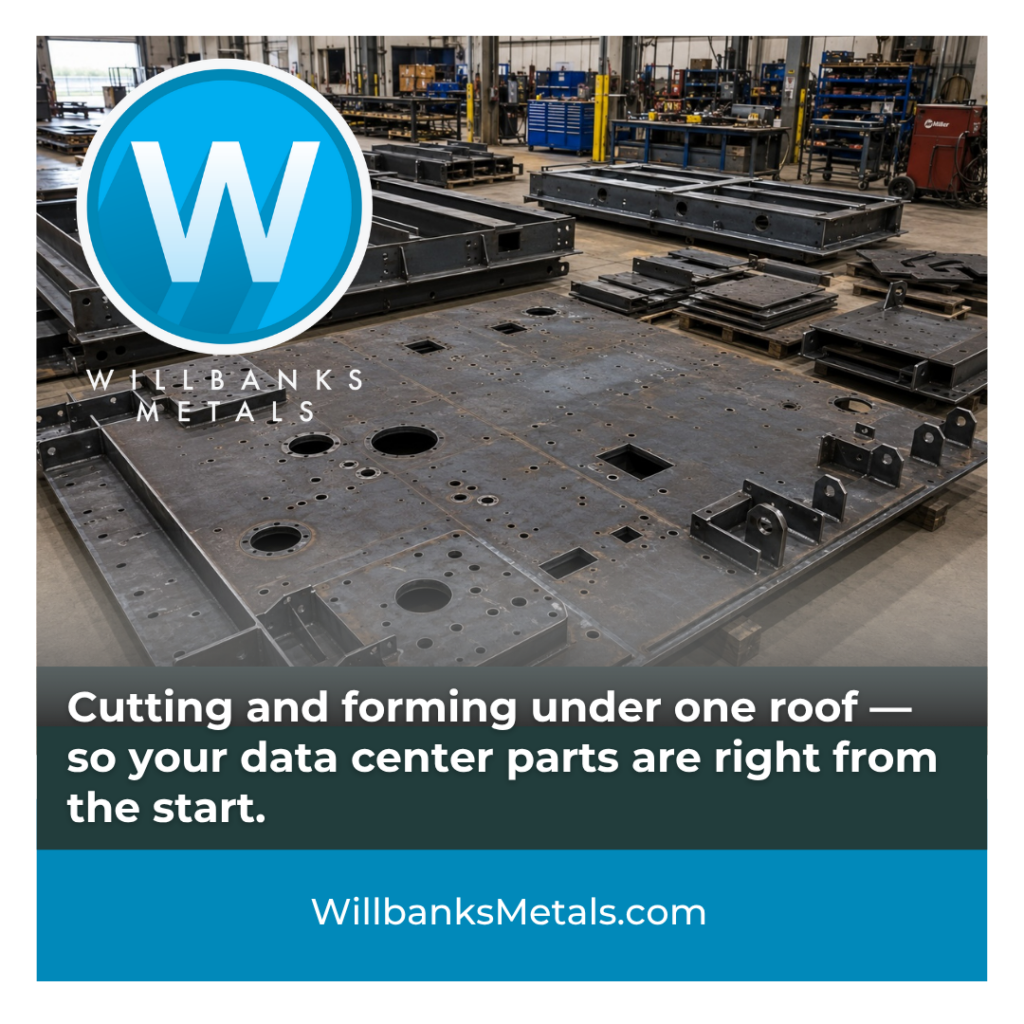
Willbanks Metals keeps cutting and forming under one roof at their Fort Worth, TX facility. That means the people cutting your parts know exactly how they’ll be formed — and they cut accordingly.
In practice, that looks like:
- Cuts that account for forming from the start — no assumptions that don’t carry through to the finished part
- Parts formed to spec, not forced to fit — because the process was built around the outcome, not assembled after the fact
- Consistency from first piece to last — so what shows up on your floor is what’s supposed to show up
If you’ve got data center prints you’re working through, Willbanks will review them early and help you think through the best way to run the job before it becomes a problem on your floor.
Frequently Asked Questions
What’s the most important thing to look for in a data center steel fabricator? A fabricator who keeps cutting and forming under one roof. When those two operations are separated, tolerances drift and coordination breaks down. That’s where most data center fabrication problems start.
How do I know if a fabricator can hold the tolerances data center work requires? Ask how they maintain consistency across a full production run, not just on a single piece. Also ask if they’ll review your prints before fabrication starts — fabricators who do that tend to understand tolerance management better than those who just take prints and run.
Why do data center steel parts fail on installation? Usually because cutting and forming weren’t coordinated. Forming changes a part — holes shift, edges move — and if the cut wasn’t made with forming in mind, the finished part won’t match the print. The fix is working with a fabricator who handles both operations together.
Does Willbanks Metals work on data center projects? Yes. Willbanks handles plate and structural steel cutting, forming, and processing at their Fort Worth facility. They review prints before fabrication starts and keep both operations in-house to reduce handoff errors and hold tighter tolerances.
Got prints? Send them over. We’ll take a look and help you think through the best way to run it.